Call for Papers
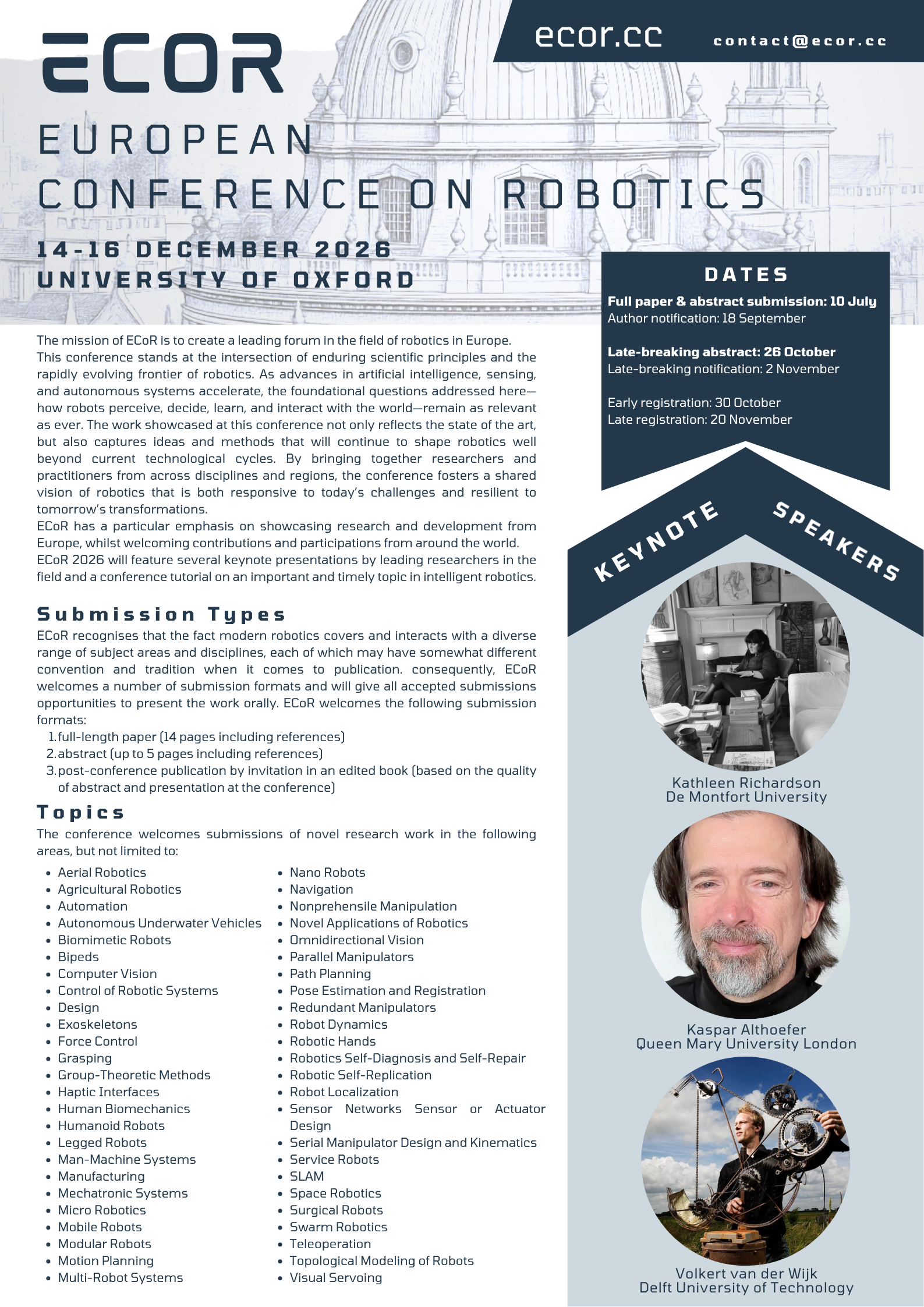
The mission of ECoR is to create a leading forum in the filed of robotics in Europe. This conference stands at the intersection of enduring scientific principles and the rapidly evolving frontier of robotics. As advances in artificial intelligence, sensing, and autonomous systems accelerate, the foundational questions addressed here—how robots perceive, decide, learn, and interact with the world—remain as relevant as ever. The work showcased at this conference not only reflects the state of the art, but also captures ideas and methods that will continue to shape robotics well beyond current technological cycles. By bringing together researchers and practitioners from across disciplines and regions, the conference fosters a shared vision of robotics that is both responsive to today’s challenges and resilient to tomorrow’s transformations. ECoR has a particular emphasis on showcasing research and development from Europe, whilst welcoming contributions and participations from around the world.
ECoR recognises that the fact modern robotics covers and interacts with a diverse range of subject areas and disciplines, each of which may have somewhat different convention and tradition when it comes to publication. consequently, ECoR welcomes a number of submission formats and will give all accepted submissions opportunities to present the work orally. ECoR welcomes the following submission formats:
- full-length paper (14 pages including references)
- abstract (up to 5 pages including references)
- post-conference publication by invitation in an edited book (based on the quality of abstract and presentation at the conference)
- Full-length papers:
- Authors are invited to submit full-length high-quality papers in both theory and/or application areas that are closely relevant to the conference. Submitted papers will be refereed on their originality, presentation, empirical results, and quality of evaluation.
- All full papers will be reviewed normally by three members of our international programme committee. ECoR will feature both oral and poster presentations and will include a number of keynote presentations. Accepted full papers will be included in the conference proceedings, published by Springer.
- Abstracts:
- ECoR also welcomes abstract submissions. Abstracts that are considered to be a good alignment with the conference and good quality will be invited to be presented orally in the same format as a full-length papers.
- Presenting author of accepted abstract is required to bring a poster to be presented in-person at the conference.
- All abstracts will be invited for a short spot-light presentation at the conference (unless already invited for a full oral presentation). This is to both enable fast dissemination of promising preliminary findings and to encourage attendance by a broader audience of early career researchers (including research students) and industrial professionals.
- Post-conference full paper by invitation:
- High quality abstracts that are well received at the conference will be invited to submit full-length papers to be included in an edited book, published by Springer.
The conference welcomes submissions of novel research work in the following areas, but not limited to:
- Aerial Robotics
- Agricultural Robotics
- Automation
- Autonomous Underwater Vehicles
- Biomimetic Robots
- Bipeds
- Computer Vision
- Control of Robotic Systems
- Design
- Exoskeletons
- Force Control
- Grasping
- Group-Theoretic Methods
- Haptic Interfaces
- Human Biomechanics
- Humanoid Robots
- Legged Robots
- Man-Machine Systems
- Manufacturing
- Mechatronic Systems
- Micro Robotics
- Mobile Robots
- Modular Robots
- Motion Planning
- Multi-Robot Systems
- Nano Robots
- Navigation
- Nonprehensile Manipulation
- Novel Applications of Robotics
- Omnidirectional Vision
- Parallel Manipulators
- Path Planning
- Pose Estimation and Registration
- Redundant Manipulators
- Robot Dynamics
- Robotic Hands
- Robotics Self-Diagnosis and Self-Repair
- Robotic Self-Replication
- Robot Localization
- Sensor Networks Sensor or Actuator Design
- Serial Manipulator Design and Kinematics
- Service Robots
- SLAM
- Space Robotics
- Surgical Robots
- Swarm Robotics
- Teleoperation
- Topological Modeling of Robots
- Visual Servoing
Submission of full paper and abstract are made via Microsoft CMT.
(The Microsoft CMT service was used for managing the peer-reviewing process for this conference. This service was provided for free by Microsoft and they bore all expenses, including costs for Azure cloud services as well as for software development and support.)